

Have you ever wondered how many mysteries surround us that our eyes cannot perceive?
When we take a photo with a mobile phone, we are recording only a small part of the electromagnetic spectrum: visible light. But what lies beyond it? What secrets are hidden outside the reach of our vision? Could information that is invisible to our eyes be used to detect diseases early or to identify adulterated substances in food? These questions, which sound like they come from a science-fiction film, are much closer to our reality than we might imagine.
Spectral imaging has emerged as an innovative technology capable of revealing the "invisible", translating the physical and chemical information of objects into the digital world. Whether checking the quality of the coffee we drink every day, monitoring a plantation to prevent crop losses, or diagnosing health problems before visible symptoms even appear, spectral analysis turns reflected light into valuable data.
Let us understand how all of this works:
Differences Between Multispectral and Hyperspectral Images
Hyperspectral and multispectral images capture a much broader range of the electromagnetic spectrum, extending beyond the visible. These technologies cover everything from ultraviolet light (UV, 200–400 nm) and visible light (VIS, 400–780 nm) to the near infrared (NIR, 780–2500 nm) and the mid infrared (MIR, 2500–25,000 nm), far surpassing the limitations of conventional cameras.
These images use the light reflected as it interacts with materials, capturing structural and spectral details arising from processes such as absorption, scattering, and transmission. In this way, they make visible information that our eyes could never see, opening doors to applications that can transform many fields of knowledge.
Spectral images can be classified as multispectral and hyperspectral, each with distinct characteristics:
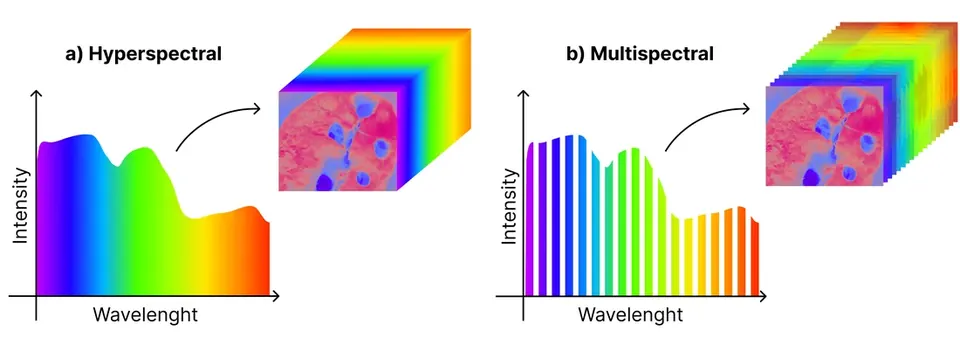 (Sabin et al., 2024)
Multispectral Images
Number of bands: They generally capture 3 to 10 spectral bands, which are broader. Typical bands include red, green, and blue (RGB), plus a few bands in the near infrared. 💡
Spectral resolution: The bands are wider (generally 20 to 100 nm), which results in less detailed spectral discrimination.
Advantages:
Simpler data acquisition, since high processing power is not required.
Equipment costs are generally lower.
The multispectral technologies developed by OpenScience use 20 to 40 wavelengths
Hyperspectral Images
Number of bands: They capture tens or even hundreds of narrow spectral bands (typically 10 to 20 nm), which form a data cube and allow very detailed analyses.
Spectral resolution: The high spectral resolution enables deep, detailed analysis, as well as the precise identification of different materials based on their unique signatures.
Characteristic | RGB images (mobile phone) | Multispectral images | Hyperspectral images |
Number of bands | 3 (RGB) | 3 to 10 | Hundreds |
Spectral resolution | Low | Medium | High |
Cost | Low | Medium | High |
How Spectral Imaging Works
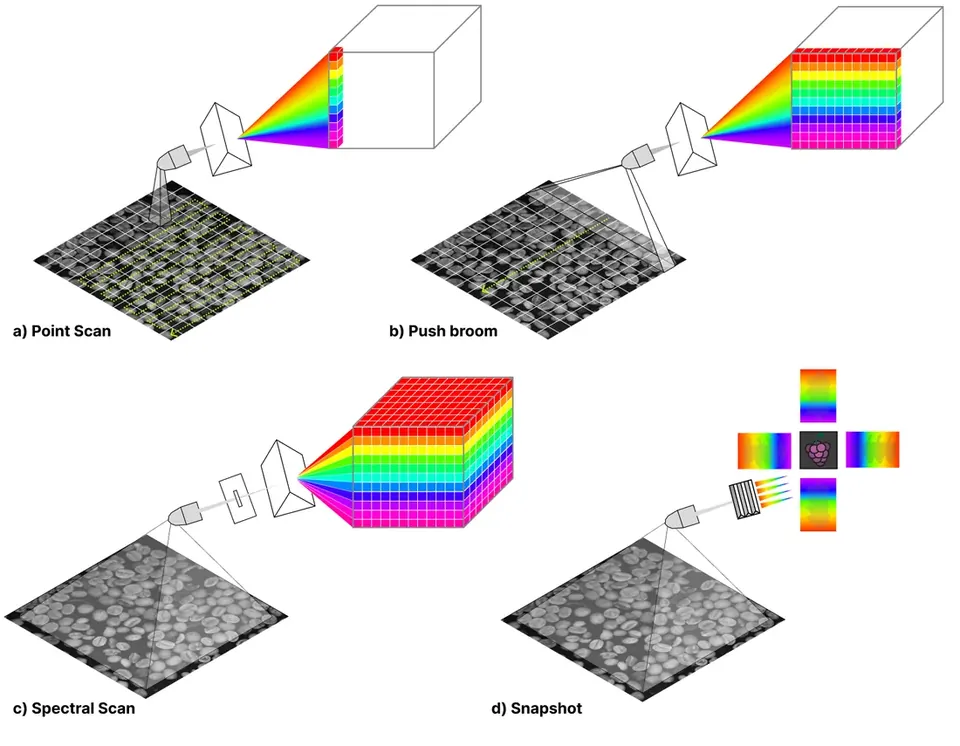 (Sabin et al., 2024)
Spectral image acquisition techniques vary according to the type of scanning and the sensor arrangement. The main categories are:
Point Scanning (Whiskbroom): The sensor scans the sample point by point, collecting the full spectrum of each point. This approach is common in benchtop radiometers and laboratory systems and usually provides high spectral resolution.
Line Scanning (Pushbroom): A line of sensors collects data from one line while the system or the object moves. This technique is widely used in remote sensing systems (satellites or drones) and in industrial applications on production conveyor belts.
Spectral Scan: It involves the spectral scanning of an object or area, in which different wavelengths are captured sequentially. It can be performed using devices such as spectrometers, which analyze the reflected or emitted light.
Snapshot: It captures all the spectral data in a single instantaneous image, allowing the simultaneous acquisition of multiple spectral bands for each pixel of the image. It is ideal for moving objects, as it eliminates problems related to scanning time and distortions associated with sensor movement. However, it usually requires more complex and expensive systems, owing to the need for advanced technology to capture all the data simultaneously.
Practical Applications
Multispectral and hyperspectral images have applications in many areas, ranging from the remote monitoring of agricultural areas, disease detection, analysis of human tissue during surgery, and assessment of pharmaceutical homogeneity, to the identification of fraud in works of art, forensic analysis, and many other applications.
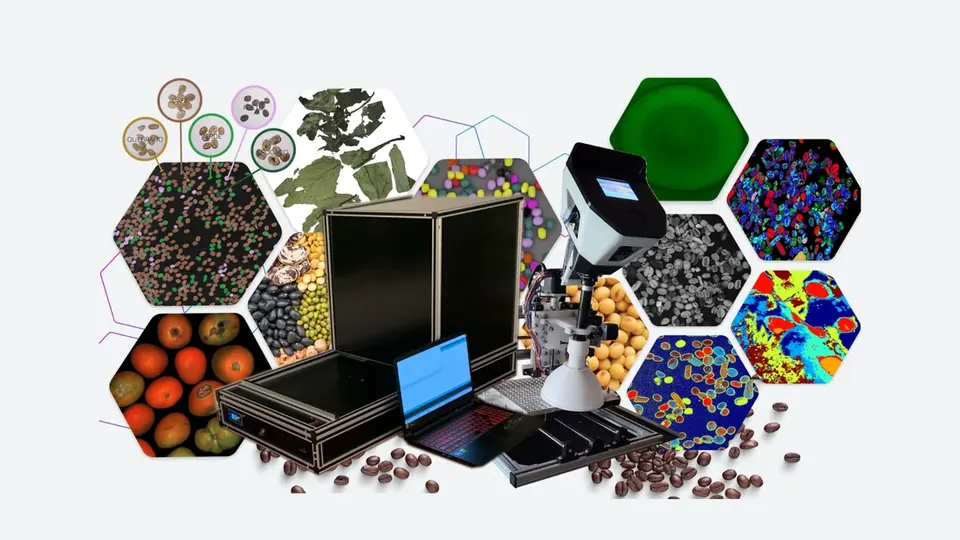 On the left we see Imajan, and beside it the Multispectral Microscope developed by OpenScience. Behind the equipment are some of the images captured with it.
Applications of Spectral Imaging - OpenScience
OpenScience is a pioneer in developing innovative and accessible solutions, promoting the democratization of spectral analysis across many markets. Among its flagship technologies are:
Low-Cost Multispectral Microscopy
This advanced multispectral microscopy system combines high resolution with portability, making it ideal for resource-limited environments or field use. With it, it was possible to identify adulterants in roasted and ground coffee, such as coffee husks, corn, barley, and açaí seeds. The equipment offers fast, non-destructive analyses, enabling the effective detection of impurities and fraud.
Hyperspectral Technology in the Coffee Production Chain
OpenScience developed a system that uses spectral imaging for the classification of coffee beans in the laboratory of a major Brazilian company. This automated equipment performs, in approximately 30 seconds, detailed analyses of hand-picking, impurities, beverage quality, moisture, and defect location directly on the image. The process is completely objective, ensuring efficiency and accuracy.
Multispectral Equipment - Imajan
Imajan is a portable, cost-effective multispectral instrument designed for the analysis of grains and vegetables. It has already been used to assess the quality of tomatoes and to classify soybean, coffee, and bean grains, accurately identifying defects and impurities directly in the captured images.
Conclusion
Spectral imaging is a powerful analytical tool, capable of providing rich information on the composition and properties of a wide range of materials at scales from the macroscopic to the microscopic. This approach has been revolutionizing fields such as agriculture, the food industry, healthcare, and geology, among others, enabling more accurate diagnoses, more efficient processes, and higher-quality products.
OpenScience stands out as a leading player in the democratization of these technologies, offering accessible solutions with high practical impact. By connecting scientific innovation, technological development, and industrial applicability, we reaffirm our commitment to making spectral analysis more accessible to Brazilian industry.
References
Sabin, G. P., Soares, F. L. F., Freitas, D. L. D. D., Silva, H. V. D. O., Antunes, C. M. M. M. O., Mohamed, E. A., Teixeira, C. A., Assis, C., Cardoso, V. G. K., & Volochen, M. (2024). Hyperspectral imaging applications. In F. A. N. Fernandes, S. Rodrigues, & E. G. A. Filho (Eds.), Chemometrics (pp. 91-123). Elsevier. https://doi.org/10.1016/B978-0-443-21493-6.00005-8